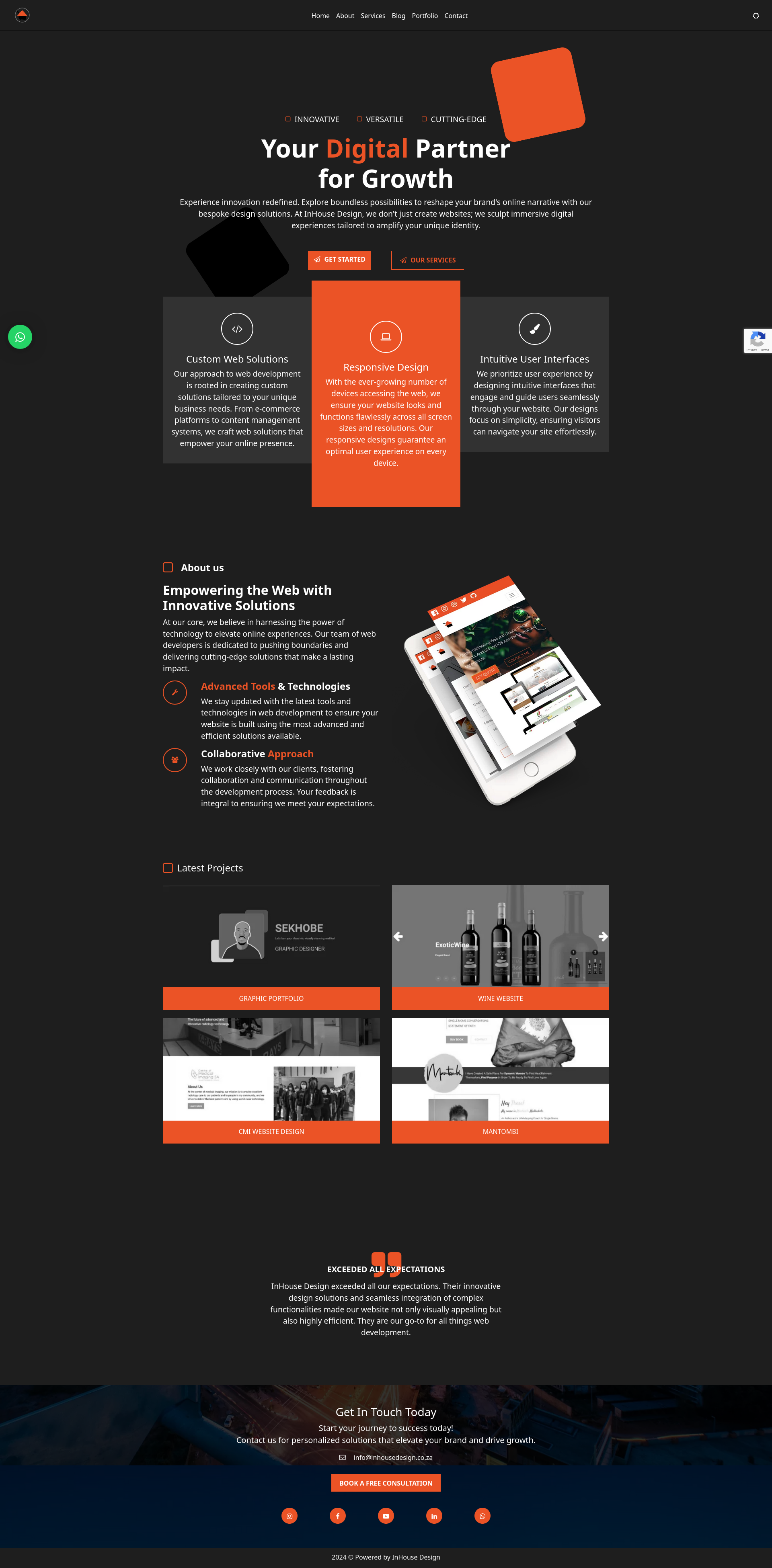
The website perfectly reflects our brand and the essence of what we do at InHouse Design. The animations add a layer of sophistication, and the performance is outstanding. Riley brought our vision to life.”
This project involved designing and developing a high‑performance, bespoke WordPress website for InHouse Design — a UX/UI‑focused digital agency. The objective was to create a platform that clearly communicates the agency’s value proposition while maintaining exceptional performance, scalability, and long‑term maintainability.
Business Goals
The primary business objectives were:
Position InHouse Design as a premium UX/UI‑driven digital agency
Clearly communicate services and expertise to potential clients
Improve website performance and SEO to support lead generation
Build a scalable foundation that can evolve with the agency’s growth
My Role & Responsibilities
I acted as the technical owner of the project, responsible for both delivery and decision‑making.
Led technical architecture and WordPress setup
Designed and built a fully bespoke WordPress theme
Defined performance, accessibility, and SEO standards
Collaborated with designers to translate Figma designs into production‑ready UI
Implemented animations using GSAP without compromising performance
Set up CI/CD deployment using GitHub Actions
Optimised for long‑term maintainability and scalability
Technical Approach & Architecture
Why Bespoke Over a Page Builder
Rather than relying on a page builder, I chose a custom Understrap‑based theme combined with Advanced Custom Fields (ACF). This approach was selected to:
Avoid technical debt commonly introduced by page builders
Achieve superior performance and Core Web Vitals scores
Maintain full control over markup, accessibility, and SEO
Enable reusable, structured content blocks
Trade‑off considered:
Slower initial build compared to page builders
Faster long‑term iteration, easier maintenance, and better scalability
Theme & Content Structure
Custom Blade‑style templates for clean separation of concerns
Modular SCSS architecture for maintainable styling
ACF‑driven flexible content blocks for editorial freedom
Minimal plugin usage to reduce attack surface and update risk
Performance & Optimisation Strategy
Performance was treated as a core requirement, not a post‑launch task.
Key optimisations included:
Optimised asset loading (CSS/JS splitting and defer strategies)
SVG‑first icon and graphic usage
Optimised image handling and lazy loading
Minimal DOM depth and clean semantic HTML
Result:
Achieved 100% Google PageSpeed scores (desktop)
Excellent Core Web Vitals
Improved SEO crawl efficiency
DevOps & Deployment
To ensure reliability and repeatability:
Implemented Git‑based version control
Automated deployments via GitHub Actions
Linux‑based hosting environment
Environment parity between local and production
This allowed safe deployments, quick rollbacks, and reduced human error.
Security & Stability Considerations
Minimal plugin footprint
Strict update and dependency management
Hardened WordPress configuration
Secure deployment pipeline
While not a high‑traffic enterprise platform, the site was built with security‑first principles suitable for future scaling.
Outcome & Results
Clearer positioning of InHouse Design’s services
Faster load times and improved SEO metrics
Flexible content system for ongoing updates
Stable, maintainable codebase ready for future growth
Key Learnings
Investing in bespoke architecture reduces long‑term cost
Performance‑first development improves both UX and SEO
Clear technical ownership leads to smoother project delivery
How This Scales to Larger Teams & Projects
This project reflects how I approach client work in agency environments:
Technical ownership from discovery to deployment
Clear trade‑off decisions aligned with business goals
Scalable systems rather than one‑off builds
Collaboration with designers, content teams, and stakeholders
The same principles apply when working within larger teams, supporting ongoing client retainers, or contributing to high‑traffic platforms.